Winning Ticket
Needful ThingsWinning Ticket is a clockwork horse-racing game that Leland Gaunt sells to Danforth Keeton, a town official whose gambling losses have led him to embezzle public money. Its uncanny success promises Keeton a way to win back what he has lost, but not a way out of the wrongdoing that has made him vulnerable to an audit. As his fortunes rise and collapse, the game becomes more than a betting aid: it gives visible form to his hope, his compulsive reliance, and his increasingly persecutory interpretation of events.
Appearance and Origins
The game appears in the window of Needful Things in a brightly colored cardboard box bearing an image of two pacers approaching a finish line. The scene looks to Keeton like Lewiston Raceway, and the name printed on the box, Winning Ticket, catches his attention so completely that he stands watching it for nearly five minutes before entering the shop.
Inside, Gaunt presents a tin raceway mounted on a platform about three feet long and a foot and a half wide. It replicates a two-mile course, with eight narrow slots and eight tin horses set behind a starting line. Each horse is fixed to a small post that passes through a slot in the track. The apparatus resembles inexpensive toys Keeton remembers from childhood, yet its carefully specified mechanics lend the game a tangible, testable appearance.
Gaunt describes Winning Ticket as a Depression-era horse-player’s Ouija board. According to his account, bettors assigned the names of horses from a newspaper or Racing Form to the tin horses, winding the game up and running each race in sequence. They then went to the track and bet on the horses that had won at home. Gaunt calls the practice seemingly superstitious while presenting its supposed results as a reason Keeton might try it; the contrast between a child’s toy and a system for selecting real bets is central to the game’s appeal.
Keeton’s First Use and Winnings
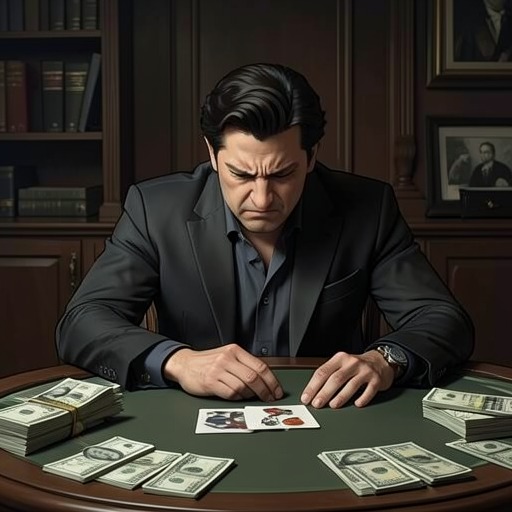
The game reaches Keeton at a moment when his finances and official responsibilities are already entangled. He has lost money at the track, concealed some of the losses from Myrtle Keeton, and covered a shortfall in the household account by taking $100 from the town’s petty-cash fund. His concealed correspondence with the Bureau of Taxation is kept in a locked filing-cabinet drawer, while the prospect of an audit threatens to expose the town’s financial records, including expense and law-enforcement budgets. By autumn 1990, Keeton has found a bookie to accommodate larger bets, but his luck has not improved. Winning Ticket therefore arrives not as a harmless diversion but as a seemingly practical answer to both mounting losses and a crisis of concealment.
Keeton pays for the game by drawing a bill from his wallet without taking his eyes off Gaunt. It is a bill bearing Thomas Jefferson, a detail that links the purchase money to the same currency associated with the trouble Keeton is trying to escape. Gaunt makes the bill disappear as neatly as a magician’s prop before raising another matter, leaving the transaction marked by both a payment and an act of misdirection.
Keeton first tests the device with historical races. He clears his desk, sets up the game, and spends much of a day running at least two dozen Kentucky Derby races using the entries in a book. The tin horses assigned the names of the actual winners repeatedly come in first. He is so absorbed that he loses track of time and nearly misses the new races scheduled at Lewiston Raceway that evening. The game’s demonstration thus shifts quickly from retrospective play to the prospect of immediate profit.
The next day, Keeton is elated: every horse he selected with Winning Ticket has won, including Malabar, a thirty-to-one shot in the tenth race. He returns to Castle Rock with more than $18,000 in his overcoat pockets. He puts the money in an envelope and hides it in the back of his study closet, inside the Winning Ticket box. For the first time in months, he has slept well, and the win seems to loosen the mental paralysis caused by the audit letter. But the winnings do not resolve the audit, repay the public money, or erase the paper trail behind his gambling.
From Hope to Dependence
The game’s success intensifies Keeton’s attachment to it. When he later calls Gaunt, he reports that it worked and that he collected on every race. His joy is so immediate that, at least temporarily, he forgets the violent plan he had been contemplating. Gaunt’s reassurance that he understands the forces Keeton believes are against him then gives Keeton a new kind of comfort: he experiences the shopkeeper as an ally who recognizes his predicament. Winning Ticket’s importance has expanded beyond its apparent ability to pick winners; it is now part of a relationship in which Keeton feels understood and supported by Gaunt.
At the same time, the game cannot change what Keeton has actually done. The threatening financial records are not merely products of his imagination: he has taken money from the town, and an audit has been demanded. When a warning slip later identifies embezzlement, it names the crime at the heart of his crisis. The game offers a possible means of covering losses, but its apparent power instead helps Keeton imagine that a successful run might restore control over circumstances created by his own decisions.
The Game After the Murder
After killing Myrtle, Keeton goes to his study and retrieves the box from the closet. The game no longer carries the excitement it once did. He sits with it, thinking that even if he could put the money back, that would not change the fact that he has murdered his wife. The prospect of punishment is filtered through his belief that unseen persecutors will not accept his explanation. In this scene, Winning Ticket remains physically available, but its promise has failed at the level that matters most: it cannot turn back the act or cancel its consequences.
The box and its contents then seem to change. Keeton first sees the picture faded and dulled, with Myrtle’s blood smeared across the pictured horses. Inside, the tin horses appear to lean at odd angles, their colors washed out, and a broken piece of spring protrudes through the winding-key opening. He interprets the damage as deliberate interference by one of the people he believes are persecuting him. His attention moves from the murder to the game’s apparent ruin, converting a broken mechanism into further evidence for his persecution narrative.
During a later telephone call, Gaunt tells Keeton to look again. Keeton sees the horses upright in their slots, their coats apparently fresh and bright, and the racecourse vivid once more. The blood on the box is now barely visible, drying to a dull maroon. The reversal does not restore Keeton’s earlier innocence or undo Myrtle’s death; instead, it makes the object’s condition seem unstable, responsive to Gaunt’s intervention, or dependent on Keeton’s perception. The game’s changing appearance leaves its promise intact while making the difference between mechanical fact and delusion harder for Keeton to trust.
Narrative Significance
Winning Ticket joins financial temptation to the material language of chance. Its miniature track turns betting into a repeatable procedure: name the horses, wind the mechanism, watch the race, and carry the apparent result to the real track. Keeton’s early returns make that procedure seem to promise mastery over chance, even as his earlier betting history shows how quickly the desire to recover losses deepens his financial danger.
The game also concentrates the story’s contrast between visible evidence and imagined persecution. Keeton’s embezzlement and the coming audit are grounded in records, correspondence, and missing money; his belief that enemies are sabotaging him turns those real pressures into a wider conspiracy. Winning Ticket can appear newly damaged and then restored, but neither appearance supplies a way to settle the audit or escape responsibility. Its final significance lies in that gap: it offers Keeton a convincing object of hope while remaining powerless against the consequences of his conduct.